
Traumatic Brain Injuries (TBI), Paralysis, and Wrongful Death Caused by Warehouse Falls
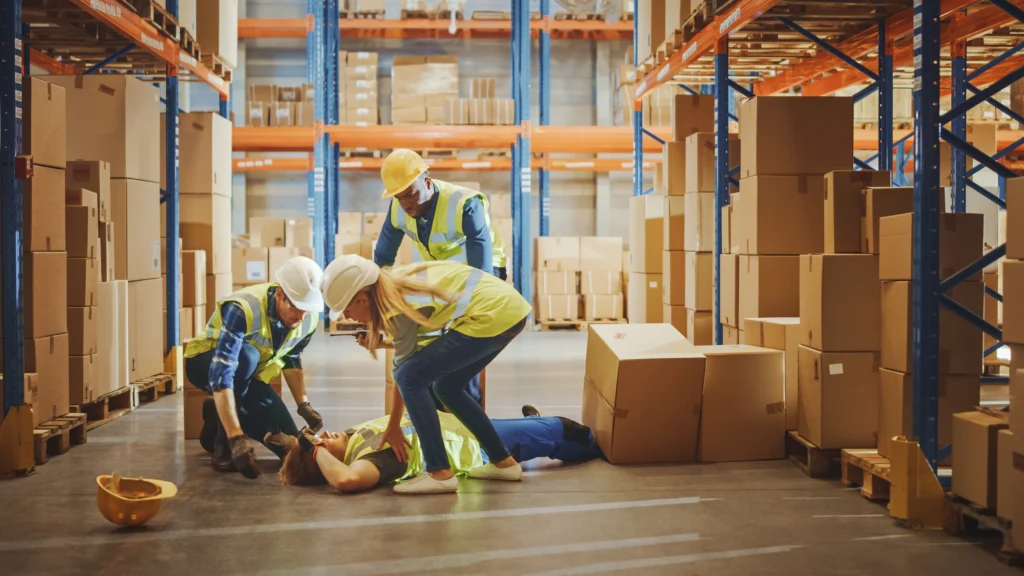
Warehouse workers have suffered permanent brain damage, paralysis, or death within seconds of a fall from a storage rack, mezzanine, ladder, loading dock, or raised pallet. A worker may strike a concrete floor, shelving, machinery, or stored materials with enough force to cause bleeding in the brain, fractured vertebrae, spinal cord damage, and lifelong disability. The central question after a catastrophic warehouse fall is whether unsafe equipment, missing fall protection, poor training, or pressure to work at height caused a preventable injury.
What Are Warehouse Height Hazards?
A warehouse height hazard is any condition that exposes a worker to a fall from one level to another. The danger is not limited to warehouse roofs or unusually tall structures.
Common warehouse height hazards include:
- Elevated storage racks
- Mezzanines and work platforms
- Loading docks and dock edges
- Fixed and portable ladders
- Order-picking equipment
- Scissor lifts and aerial lifts
- Stairs without secure railings
- Open floor holes and unguarded edges
- Workers standing on pallets, boxes, shelving, or forklift forks
- Employees climbing storage racks to reach inventory
Warehouses change throughout the workday as employees move inventory, open loading doors, reposition equipment, and restack products. The Occupational Safety and Health Administration identifies slips, trips, falls, powered industrial trucks, and material-handling equipment among the hazards warehouse employers must address.
A task does not have to appear unusually dangerous to cause catastrophic harm. A fall of several feet onto concrete can cause a traumatic brain injury, a spinal cord injury, or fatal trauma, particularly when the worker cannot brace for impact or strikes equipment while falling.
How Can a Warehouse Fall Cause a Traumatic Brain Injury?
A traumatic brain injury occurs when an external force disrupts normal brain function. During a warehouse fall, the worker’s head may strike the floor, a storage rack, a conveyor, a forklift, or stored merchandise.
Brain damage can also occur when the force of the fall causes the brain to move rapidly inside the skull, even when there is no open head wound.
Potential warehouse fall injuries include:
- Concussion
- Brain contusion
- Skull fracture
- Subdural or epidural hematoma
- Intracranial bleeding
- Diffuse axonal injury
- Brain swelling
- Seizures
- Cognitive impairment
- Permanent changes in memory, judgment, speech, or behavior
Some symptoms begin immediately. Others may not become apparent until hours or days after the incident.
Warning signs can include loss of consciousness, confusion, repeated vomiting, severe headache, slurred speech, unusual behavior, weakness, balance problems, or increasing drowsiness. A worker who strikes their head may require prompt medical evaluation even when the injury initially appears minor.
Severe brain injuries can affect far more than memory or concentration. An injured worker may lose the ability to return to work, drive, manage personal care, communicate effectively, or live independently. Families may need to coordinate neurological care, rehabilitation, home assistance, and long-term financial support.
How Can a Warehouse Fall Damage the Spine?
The impact from a warehouse fall can fracture or dislocate the vertebrae that protect the spinal cord. Bone fragments, swelling, bleeding, or displaced spinal structures may then compress or damage the cord and surrounding nerves.
Potential spinal injuries include:
- Herniated or ruptured discs
- Fractured vertebrae
- Spinal instability
- Spinal cord compression
- Nerve-root damage
- Chronic neuropathic pain
- Loss of bowel or bladder control
- Paraplegia
- Quadriplegia
- Respiratory impairment
- Permanent loss of mobility
A worker does not need to land directly on the neck or back to suffer severe spinal trauma. A feet-first landing can transmit force upward through the legs and spinal column. A twisting fall may also fracture vertebrae or damage discs, ligaments, and nerves.
Severe spinal injuries may require emergency surgery, inpatient rehabilitation, mobility equipment, home modifications, ongoing therapy, and long-term personal assistance.
Which Warehouse Practices Create the Greatest Fall Risks?
Catastrophic warehouse falls often result from a combination of unsafe conditions rather than one isolated act.
Lifting Workers on Forklifts or Pallets
Forklifts are designed primarily to move materials. A standard wooden pallet is not a safe personnel platform.
OSHA documented a fatal incident involving a warehouse worker who fell approximately seven feet from a wooden pallet elevated by a forklift. Workers at the facility commonly stood on pallets to reach inventory stored on upper racks. The worker slipped while moving products and later died from his injuries.
OSHA identified several failures, including the lack of equipment designed to help workers safely reach elevated inventory and the failure to prohibit employees from using pallets on forklifts as improvised work platforms.
Employers should provide equipment designed for elevated personnel work when employees must reach inventory at height. Improvised methods may leave workers without guardrails, stable footing, fall restraint, or a safe way to enter and exit the platform.
Climbing Storage Racks
Workers may climb pallet racks when ladders, lifts, or order-picking equipment are unavailable, inconvenient, or located too far from the assigned task. Supervisors may also tolerate rack climbing when production quotas take priority over safety.
Storage racks are not ladders. Crossbeams may be slippery, damaged, obstructed, or unable to provide secure handholds. Climbing can also destabilize stored products and expose workers below to falling inventory.
An investigation should determine whether management knew workers were climbing racks, whether the practice was common, and whether employees had practical access to safer equipment.
Using Unsafe or Improvised Ladders
Warehouse ladder falls can occur when employees use:
- Damaged ladders
- Ladders that are too short for the task
- Unsecured extension ladders
- Boxes, pallets, or shelving as substitutes for ladders
- Ladders placed on wet or uneven floors
- Ladders positioned in forklift travel lanes
- Ladders that do not provide stable access to elevated inventory
Workers may also be injured when they stand on prohibited steps, lean beyond the side rails, or attempt to climb while carrying bulky products.
McEldrew Purtell provides additional information about serious falls involving ladders, scaffolds, and elevated work areas.
Unguarded Mezzanines and Work Platforms
Mezzanines allow warehouses to use vertical space, but open edges can expose employees to severe fall hazards. Guardrails, gates, toe boards, and safe access points must remain secure and usable.
Dangerous conditions can develop when:
- Loading gates are left open
- Guardrails are removed or damaged
- Stored products block walkways
- Employees must work close to an exposed edge
- Floor openings are not covered or marked
- Workers must step around inventory or equipment
- Lighting is inadequate
A written rule requiring workers to stay away from an edge is not a substitute for physical fall protection when the work regularly places employees near that edge.
Loading Dock Falls
Loading docks create an abrupt drop between the warehouse floor and the yard, trailer, or roadway below. Workers may fall when:
- Dock doors are open without a trailer present
- Gates, chains, barriers, or visual warnings are missing
- Poor lighting hides an open edge
- Dock plates shift or fail
- A trailer pulls away unexpectedly
- Water, ice, oil, or debris creates a slippery surface
- Employees walk backward while moving freight
- Inventory blocks the worker’s view
A loading dock fall may also place the worker in the path of a truck, trailer, forklift, or moving cargo.
These incidents may involve both workplace safety failures and dangerous property conditions, depending on who owned, operated, maintained, or controlled the facility.
Inadequate Fall Protection
Depending on the task and equipment involved, workers may need guardrails, approved personnel platforms, personal fall-arrest systems, ladder safety systems, or other protections.
Providing a harness alone does not make elevated work safe. The equipment must be appropriate for the task, properly fitted, connected to a suitable anchorage point, inspected, and supported by effective training and rescue procedures.
Employers must also consider whether a worker could strike a lower-level storage rack, machine, or other obstruction before a fall-arrest system stops the fall.
How Does Production Pressure Contribute to Warehouse Falls?
A warehouse fall investigation should examine more than the worker’s actions during the final seconds before impact.
Employees may take unsafe shortcuts when companies impose unrealistic pick rates, understaff shifts, fail to provide working equipment, or discipline workers for delays. A company may have written safety rules while undermining those rules through daily production demands.
Important questions include:
- Was safe access equipment available near the work area?
- Were workers expected to climb racks or stand on pallets to meet quotas?
- Did supervisors know employees were using unsafe methods?
- Were previous complaints or near misses documented?
- Was damaged equipment removed from service?
- Were temporary and contract workers properly trained?
- Could workers stop an unsafe task without discipline?
- Were safety rules enforced consistently across shifts?
- Did productivity incentives encourage workers to bypass safety procedures?
A safety policy that exists only in an employee handbook does not protect workers when supervisors permit or reward unsafe practices.
Who May Be Responsible for a Catastrophic Warehouse Fall?
Responsibility depends on the worker’s employment status, the location, the equipment involved, contractual relationships, and the law of the applicable jurisdiction.
Potentially responsible parties may include:
- Warehouse operators
- Property owners
- General contractors
- Staffing companies
- Logistics contractors
- Maintenance companies
- Storage-rack installers
- Equipment rental businesses
- Ladder, lift, platform, or fall-protection manufacturers
- Companies responsible for inspecting or repairing equipment
Workers’ compensation may provide certain benefits to an employee injured on the job, but it may not be the only potential source of recovery. A separate third-party claim may be available when a company other than the worker’s direct employer contributed to the incident.
For example, a third-party case may involve defective equipment, negligent maintenance, unsafe property conditions, improperly installed storage racks, or the conduct of another contractor. The available claims depend on the facts and jurisdiction.
In these investigations, McEldrew Purtell handles complex construction and workplace injury cases to identify the companies that controlled the work, equipment, and hazardous conditions.
What Evidence Should Be Preserved After a Warehouse Fall?
Warehouse conditions can change quickly after an injury. Inventory may be moved, equipment repaired, surveillance footage overwritten, and temporary workers transferred to another location.
A complete investigation may require:
- Surveillance and security footage
- Photographs and measurements of the scene
- Forklift and lift data
- Equipment inspection records
- Maintenance and repair records
- Training documents
- Equipment manuals
- Incident and near-miss reports
- Work orders
- Staffing records
- Production quotas and performance data
- Text messages, emails, and supervisor communications
- Witness statements
- OSHA records
- The ladder, pallet, lift, harness, or platform involved
Evidence must also document the full medical and financial impact of the injury. This may include neurological testing, imaging, rehabilitation records, future-care evaluations, lost earning capacity, and testimony about how the injury changed the worker’s daily life.
Prompt evidence preservation is especially important when multiple employers, contractors, equipment suppliers, or property-management companies may be involved.
Warehouse Falls Are Often Preventable
Falls should not be treated as an unavoidable part of warehouse work. Employers and other companies that control warehouse operations can reduce the risk by:
- Planning elevated work before it begins
- Providing proper ladders, lifts, and personnel platforms
- Guarding mezzanines, docks, and open edges
- Prohibiting workers from standing on pallets or forklift forks
- Separating elevated work from forklift traffic
- Inspecting ladders, platforms, racks, and fall-protection equipment
- Training workers in a language they understand
- Correcting known hazards and near-miss conditions
- Allowing employees to stop unsafe work
- Ensuring production demands do not override safety procedures
Warehouse workers may also face catastrophic risks from conveyors, compactors, balers, palletizers, and automated systems, particularly when lockout/tagout procedures are not properly followed and machinery is left energized during maintenance, cleaning, or clearing jams, creating a risk of severe crush injuries, amputations, and other life-altering harm.
Height hazards require the same level of planning and control. When proper protections are missing, a single fall can cause permanent brain damage, spinal cord injury, paralysis, or death.
What Happens When a Warehouse Fall Is Fatal?
A fatal warehouse fall affects far more than the worker who died. Families may lose income, health insurance, household support, parental care, and the companionship of someone central to their lives.
A thorough investigation should determine:
- Who controlled the warehouse and work area
- Who selected and maintained the equipment
- Whether supervisors permitted unsafe elevated work
- Whether previous falls or near misses occurred
- Whether fall protection was required and available
- Whether production demands contributed to the incident
- Whether defective equipment or unsafe property conditions played a role
When negligence or a defective product contributes to a fatal fall, surviving family members may need to evaluate a potential wrongful death claim. The available claims and deadlines depend on the facts and applicable law.
McEldrew Purtell Investigates Catastrophic Warehouse Falls
Catastrophic warehouse fall cases may involve workplace safety rules, property control, defective equipment, contractor relationships, medical causation, and long-term care needs. Identifying every responsible party requires more than reviewing the employer’s incident report.
McEldrew Purtell investigates warehouse falls involving:
- Traumatic brain injuries
- Spinal cord injuries
- Paralysis
- Fatal head and spinal trauma
- Unsafe ladders and work platforms
- Forklifts used to elevate workers
- Unguarded loading docks and mezzanines
- Defective safety equipment
- Negligent maintenance
- Third-party contractors and property owners
The firm works to preserve physical evidence, obtain video and operational records, identify the companies that controlled the work, and evaluate the full impact of a catastrophic injury.
Contact McEldrew Purtell
A warehouse fall can leave a worker and family facing permanent brain damage, paralysis, lost income, extensive rehabilitation, or death. McEldrew Purtell investigates whether unsafe equipment, inadequate fall protection, dangerous property conditions, contractors, or defective products contributed to the harm.
Workers and families affected by a serious warehouse fall may contact McEldrew Purtell for a free consultation. Attorneys handling a catastrophic brain injury, spinal cord injury, paralysis, or wrongful death case involving warehouse operations are also invited to contact the firm to discuss a referral or co-counsel relationship.